
Dental Excellence · @CHIANGMAI

FREQUENTLY
ASKEDby LERTS

Treatments, pricing, sterilization, payment, visiting from abroad — everything our team gets asked the most, answered in plain English.

Porcelain Veneers

About veneers.

What is the difference between dental veneers and crowns?

Veneers cover only the front surface of a tooth (0.3–0.7 mm thick) for cosmetic enhancement. Crowns cover the entire tooth and are used after major damage or root canal treatment. Veneers preserve more natural tooth structure; crowns provide full protection.

How long do porcelain veneers last?

High-quality porcelain veneers placed at our clinic typically last 10 to 20 years. Lifespan depends on oral hygiene, avoiding hard biting habits, and wearing a night guard if you grind. We provide aftercare support and remote video follow-up.

Will veneers damage my natural teeth?

Our minimally invasive approach removes only 0.3–0.5 mm of enamel — about the thickness of a fingernail. For some cases, ultra-thin veneers require no enamel reduction at all. The natural tooth remains healthy underneath.

How much do veneers cost at LERTs Dental?

Ceramic veneers start from ฿12,000 per tooth. The price includes digital smile design preview, e.max porcelain material, lab fees, and aftercare support. Full smile makeovers typically involve 6–10 veneers.

What's the difference between e.max and zirconia veneers?

e.max (lithium disilicate) offers exceptional translucency and a natural look — best for front teeth. Zirconia is stronger but more opaque, often used on back teeth or cases needing extra durability.

Straumann Implants

About implants.

Is the dental implant procedure painful?

Implant placement is performed under local anesthesia, so you won't feel pain during surgery. Post-operative discomfort is typically mild — similar to a routine tooth extraction — and managed with standard pain relievers for 2–3 days.

How long does a dental implant last?

A Straumann titanium implant fixture can last a lifetime with good oral hygiene. The zirconia crown attached on top typically lasts 15–25 years before potentially needing replacement due to normal wear.

How much does a dental implant cost?

Straumann implants start from ฿50,000 per tooth. The price covers the implant fixture, abutment, zirconia crown, 3D CBCT scan, guided surgery, and follow-up care. Complimentary bone grafting is available for Thai patients when the CBCT scan shows only minor augmentation is needed and it can be done together with implant placement; major or staged grafting and sinus lifts are quoted separately.

How long does the full implant treatment take?

Standard treatment takes 3–6 months from placement to final crown. The implant needs about 3 months to integrate with the jawbone (osseointegration) before the permanent crown is fitted. Timing depends on your bone condition and individual healing.

Am I a candidate for dental implants?

Most healthy adults with sufficient jawbone are candidates. We assess suitability with a complimentary 3D CBCT scan at your consultation. Heavy smokers or patients with severe gum disease may need preliminary treatment first.

Invisalign

About clear aligners.

What is Invisalign and how does it work?

Invisalign uses a series of clear, custom-made plastic aligners. You wear each set for 1–2 weeks, 20–22 hours per day, removing them only to eat and brush. Teeth gradually move according to a digital treatment plan in ClinCheck software.

How long does Invisalign treatment take?

Most cases complete in 6–18 months. Simple alignment can finish in 3 months; comprehensive bite correction up to 24 months. Treatment time depends on case complexity and patient compliance with wear time.

How much does Invisalign cost in Chiang Mai?

Invisalign Express starts from ฿69,000 for short cases. Comprehensive treatment ranges ฿120,000–฿180,000. Price includes 3D scan, treatment plan, all aligners, retainers, and follow-up visits.

Can I eat normally with Invisalign?

Yes — aligners are removable for eating, so there are no food restrictions like with metal braces. We recommend brushing before reinserting the aligners to prevent staining and decay.

Will I need a retainer after Invisalign?

Yes — every orthodontic case requires retainers to maintain results. We provide Vivera retainers (same technology as Invisalign but thicker and more durable). Wear nightly for the first 6 months, then several nights per week long-term.

Zoom Whitening

About whitening.

Is Zoom WhiteSpeed teeth whitening safe?

Yes — Zoom WhiteSpeed by Philips is FDA-cleared and dentist-supervised. The gel includes potassium nitrate and ACP to reduce sensitivity. Some patients experience mild sensitivity for 24–48 hours, which resolves on its own.

How much whiter will my teeth get?

Most patients see up to 8 shades improvement in a single 60-minute session. Results last 1–3 years depending on diet (coffee, wine, smoking) and oral hygiene.

How much does Zoom whitening cost?

In-clinic Zoom WhiteSpeed whitening is ฿9,900. The price includes pre-treatment cleaning, the full 60-minute procedure, aftercare guidance, and take-home maintenance gel.

Can I whiten teeth at home instead?

Yes — we offer a take-home whitening kit at ฿4,500 with custom trays and clinic-grade gel. Use 30–60 minutes daily for 2 weeks. Results are comparable to Zoom but require more time.

About Our Clinic

About visiting us.

Where is DentalExcellence by LERTs located?

Our clinic is at 1 Atsadathon Road, Si Phum, Mueang Chiang Mai District, Chiang Mai 50200 — inside the old city moat, near Thapae Gate. Parking available, easy access by Grab or songthaew from major hotels.

Do you treat international patients?

Yes — we regularly treat international patients visiting Chiang Mai. Our team is fluent in English. We coordinate appointments around your travel itinerary and offer free video consultation before you arrive.

What are your hours?

Tuesday–Sunday, 10:00 AM – 7:00 PM. Closed Mondays. Book by phone (66) 65-955-2325, WhatsApp, email [email protected], or the website form.

How is your sterilization process?

We follow international infection-control standards. Instruments go through ultrasonic cleaning, sealed sterilization pouches, then a Class B autoclave at 134°C. Single-use items (needles, suction tips, gloves) are discarded after each use. Water lines flushed and disinfected daily.

Do you offer emergency dental care?

Yes — emergencies during clinic hours (Tue–Sun 10AM–7PM). Call (66) 65-955-2325 first so we can prepare a slot. After hours, we provide guidance over phone/WhatsApp and arrange next-day appointments.

Payment & Consultation

About payment & booking.

What payment methods do you accept?

Cash, all major credit cards (Visa, Mastercard, AMEX, JCB), bank transfer, and Thai QR Code. Installment plans available through partner banks for treatments over ฿20,000. Ask for current installment options at consultation.

How do I book a consultation?

Call (66) 65-955-2325, message us on WhatsApp at the same number, email [email protected], or fill the website form. First consultations are complimentary (30–45 minutes) including exam and treatment plan.

Is the first consultation really free?

Yes. The first consultation includes an oral exam, treatment options review, and written quote. Panoramic or 3D CBCT X-rays are charged separately if required for diagnosis.

Dr. Wasit Lertwanich, DDS — Founder of Dental Excellence by LERTs
Deep Talk · In conversation

Straight answers from Dr. Wasit.

Beyond prices and timelines — the questions patients really ask once they're in the chair. Honest, unhurried answers from the dentist who will actually do the work.

Dr. Wasit Lertwanich, DDS Implant & Cosmetic Specialist · Founder of LERTs
A dentist overseas said my tooth is cracked, infected and can't be saved — do I pull it and place the implant in one go?

If a tooth genuinely has to come out, it comes out — that part's straightforward. The real question is how best to replace it, and that's where our own 3D CBCT, taken right here, earns its place: it shows me exactly how much bone you have and whether you'll need a graft, so I can read it and plan your whole case with you in the same visit, in about ten minutes. From there it comes down to timing. With deep enough bone and no active infection, I can extract and place the implant in one surgery. If there's infection to clear or the bone's too thin, I stage it — extract and graft first, heal a few months, then place — two surgeries, but onto solid ground, which is how implants last. Here are both paths side by side:
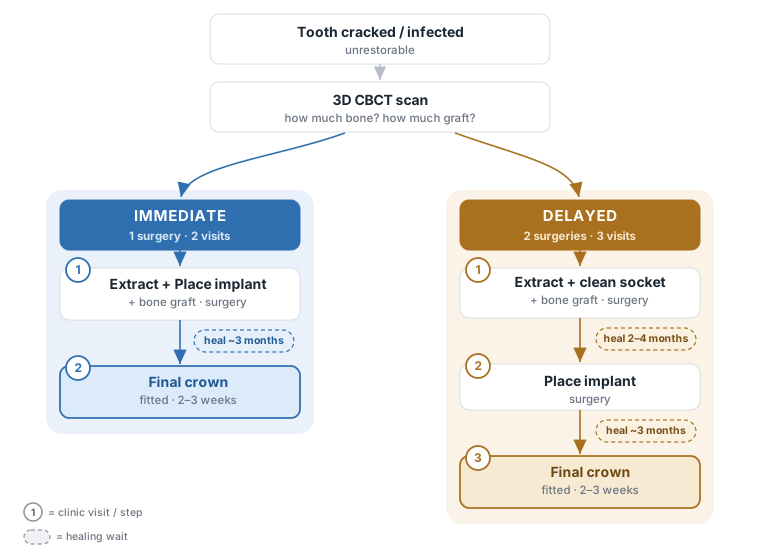
Flowchart comparing immediate implant placement (1 surgery, 2 visits) with delayed placement (2 surgeries, 3 visits), with healing times and final crown.
Same start, same finish — the difference is how many surgeries, healings and visits.
I really want implants, but the surgery frightens me — will I be knocked out, and what if I can't cope in the chair?

You don't need to be put to sleep. Everything from a single tooth up to a full-arch All-on-4 is done under local anesthetic — you stay awake but feel nothing, and go home the same day without the grogginess or risks of general anesthesia. If the worry itself is the hard part, I won't just tell you to relax: beforehand I can give you a mild tablet to settle the nerves, and during surgery we can add nitrous oxide ("laughing gas"), which takes the edge off in a minute and clears just as fast. You're in control the whole time — lift a hand and we pause.

So many implant brands at such different prices — does it really matter which one I get?

Honestly, the titanium itself is often much the same between brands — a well-known implant usually costs more for the same material. What the extra really buys is recognition over time: an implant lives in your jaw for 20–30 years and will likely need a part serviced one day, by which point you could be anywhere in the world. A globally-established system means any dentist can identify it and order the right component; an obscure, cut-price one risks the opposite — nobody recognizes it, nobody can fix it. That's why I use traceable systems like Straumann — not because the metal is special, but because it stays fixable wherever life takes you.

How do you choose a veneer shade that actually looks like me — not a fake, too-white smile?

The blinding, brightest-white "Hollywood" smile was a trend twenty years ago — today it just reads as fake. A natural smile isn't about going as white as possible; it's picking a shade that belongs to your face. My simplest rule: I match the brightness to the whites of your own eyes — teeth brighter than that look false every time, while teeth sitting right at or just below it look healthy and real. From there I read your skin tone, age and lip line, and we try the shade on your own teeth — a mock-up you approve in the mirror — before I prepare anything. The goal is that people think you look well-rested, not that you've "had your teeth done."

Still wondering? Just ask.

A specialist will reply personally — usually within a few hours.